
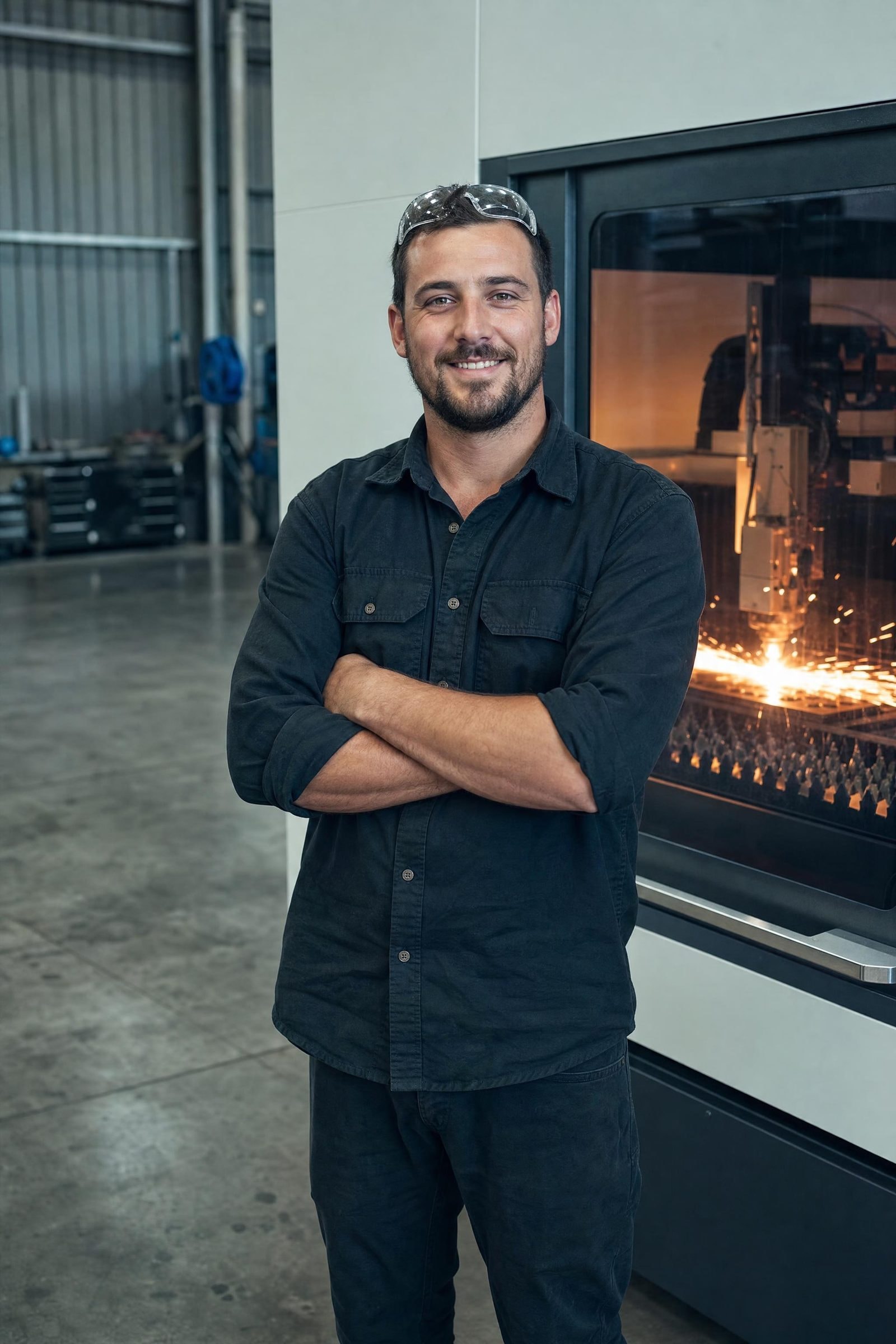
Manufacturing equipment
Laser cutter finance from 48+ Australian lenders.
A fibre laser can replace outsourced cutting entirely. We fund the machine, the chiller, the extraction and the install so the whole line lands on one contract.
 340 client reviews


One broker from your first call through to funding.
See which laser cutter finance options fit your business.
Tell us what you are buying. A Lyft Money broker compares 48+ lenders and explains the rate, balloon, fees and total cost before you decide.
Access to 21+ laser cutter finance lenders
Lenders on our panel that fund laser cutter finance.




















At a glance
Laser cutter finance: the numbers that matter.
- Typical price
- $80,000 – $1,200,000
- Terms
- Up to 84 months
- Indicative rates
- 6.9% – 14.5% p.a.
- Typical speed
- 24–48 hours for low-doc up to $150k; longer for full-doc
- Usual structure
- Chattel mortgage
- Useful life
- About 12 years
In plain English
What is laser cutter finance?
Laser cutter finance is funding for a fibre or CO2 laser cutting system, secured against the machine. Fibre lasers have transformed Australian sheet metal fabrication, and because the machines are high-value and productive, lenders generally fund them over five to seven years including installation and extraction.
Fibre laser cutting has reshaped Australian fabrication. Machines that once cost seven figures are now available at a fraction of that, and cutting speeds on thin material are dramatically faster than plasma or CO2. For a fabricator, bringing cutting in house removes lead times, reduces the cost per part and opens up work that was previously uneconomic to quote. It also gives you control over quality, which is difficult to guarantee when cutting is subcontracted out.
The purchase is a project rather than a single item. A laser needs a chiller, dust extraction, clean compressed air, adequate three-phase power and a slab that can take the weight. Getting all of that into one quote means it can all be funded on one contract. Your broker will also compare a chattel mortgage against a lease, since some fabricators prefer to upgrade source power every five years as technology moves.
How lenders assess laser cutter finance
Lenders assess laser cutters on brand, source power, resonator type and hours. Fibre lasers from established manufacturers hold value considerably better than budget imports, which affects both the amount funded and the term. Chillers, extraction, compressors, nesting software and installation can be included when invoiced together. Machines imported directly need import and compliance documentation and lenders may require inspection on arrival. Deposits to overseas suppliers are commonly funded, with settlement completed once the machine is installed.
New or used
New fibre lasers dominate, with pricing having fallen sharply as Chinese manufacturers entered the market; used CO2 machines are cheap but running costs are much higher.
Before you buy
- Match source power to your thickest regular material; buying a 3kW machine to occasionally cut 20 mm plate will frustrate you daily.
- Price the full installation — chiller, extraction, compressed air and three-phase power are all mandatory and often quoted separately.
- Check local service response times and consumable supply, because a laser waiting on a nozzle or lens from overseas is dead capital.
Commonly financed
- Bystronic ByStar Fiber
- Trumpf TruLaser 3030
- Amada ENSIS
- HSG Laser G3015
- Bodor P series

A clear next step
How to finance a laser cutter.
Our AI helps check lender fit across 48+ lenders. Your broker reviews the options and explains what they mean for you.
- 01
Confirm the asset
Dealer or private sale, new or used, price and age of the asset.
- 02
Structure the loan
Term, deposit and balloon matched to cash flow and asset life.
- 03
Settle and collect
Lender pays the supplier directly; you take delivery.
- ID and ABN
- Invoice or quote for the asset
- Bank statements or financials depending on amount
The lender makes the final credit decision. Available options depend on your business and the lender’s assessment.
Before you make a decision
Estimate your laser cutter repayments.
Adjust the price, rate, term and balloon to see the repayment and the total cost over the term.
- Number of repayments
- 60
- Balloon at end of term
- $128,000
- Total interest (est.)
- $181,167
- Total repaid (est.)
- $821,167
This calculator is a guide only. It uses simplified assumptions, excludes fees and charges unless stated, and is not an offer or quote. Actual repayments are confirmed by the lender in its loan contract.
From Lyft Money clients
Clear advice.
People who stay in touch.
Rated 5.0 from 340 Google reviews across the types of finance we arrange. Read them on Google.
“keeping us informed every step of the way”
“He explained all the financing options clearly”
“helped out my business”
Ways to finance a laser cutter
Key terms
What is laser cutter finance?
Laser cutter finance is a secured loan or lease used to buy a fibre or CO2 laser cutting system, with the machine as security. Terms commonly run 48 to 84 months and ancillary equipment such as chillers and extraction can be funded on the same contract.
Fibre laser or CO2 laser?
A fibre laser cuts metal faster on thin to medium material, uses far less power and has fewer consumables, which is why it now dominates metal fabrication. A CO2 laser still suits non-metals such as acrylic, timber and fabric, where fibre wavelengths are less effective.
Can I finance a laser cutter that is built to order overseas?
Yes. Progress payments to the manufacturer can be funded by the lender or through a trade finance facility and rolled into a chattel mortgage when the machine is installed and commissioned. Tell your broker the payment schedule so the structure is ready before the deposit is due.
Can I finance a fibre laser with the automation and extraction?
Yes. Load and unload automation, sheet towers, fume extraction, chillers, compressors and nesting software can be financed with the laser when quoted together, and installation and training are usually included too. One contract keeps the rate sharper than several loans.
How do lenders treat high-value lasers over $500,000?
Lasers above the low-doc limits are financed on financials, with lenders looking at the fabrication business’s history, the contracts and capacity behind the purchase and the machine’s brand. Terms of five to seven years are common. A broker can also split a very large purchase across two lenders or combine bank and equipment lender funding.
Can I upgrade from a CO2 laser to fibre with finance?
Yes. Lenders finance the new machine and can take the old one as a trade-in through the dealer or let you sell it privately and pay out any remaining finance from the proceeds. Energy and consumable savings on a fibre laser often cover a good part of the repayment, which strengthens the case.
Do I need a deposit for equipment finance?
Often no deposit is required, particularly for established businesses buying standard assets from a dealer. A deposit is more likely where the business is new, the asset is older or specialised, the credit profile is weaker, or the amount is large relative to turnover. Deposits typically range from around 10% to 30% in those cases. Putting money in reduces the amount financed and can improve the terms offered, but it is not always necessary.
What fees are normally charged on equipment finance?
The common ones are an establishment or documentation fee charged at settlement, a monthly account-keeping fee, and a PPSR registration fee for recording the lender's interest in the asset. A brokerage fee may also apply, which we disclose to you in writing before anything is submitted. Some agreements include an early termination or break cost. Fees vary by lender and are typically a modest part of total cost compared with the interest, but they should still be compared.
How large a balloon can I set?
Lenders publish maximum residual or balloon percentages that fall as the term lengthens, because the asset is worth less at the end of a longer term. For a vehicle, a common pattern is up to roughly 50% on a two-year term, reducing to around 20% to 30% on a five-year term. The ATO also sets minimum residual values for finance leases. A larger balloon lowers monthly repayments but increases total interest and leaves a lump sum to deal with at the end.
Is hire purchase still used in Australia?
It is far less common than it once was. Under hire purchase the financier owns the asset and you hire it, with ownership transferring automatically after the final instalment. Since the GST changes that made chattel mortgage more attractive for businesses accounting on a cash basis, most equipment lending is written as a chattel mortgage or lease instead. Some lenders still offer commercial hire purchase, and your accountant can advise whether it suits your circumstances.
What is PPSR registration and why does the lender do it?
The Personal Property Securities Register is the national register of security interests in personal property, including vehicles and equipment. When a lender finances an asset, it registers its interest so the security is publicly recorded and its priority is protected if the asset is sold or the business fails. It also means a buyer searching the register will see the finance. The registration is released once the contract is paid out, and a small registration fee is usually passed on to you.
How does a balloon payment work on a chattel mortgage?
A balloon is a lump sum left to pay at the end of a chattel mortgage, which lowers the regular repayments during the term. For example, a 30 per cent balloon on a $100,000 vehicle leaves $30,000 to pay at the end, so the monthly amount is calculated on $70,000 plus interest on the full balance. Balloons are commonly set between 0 and 40 per cent depending on the asset and term, and at the end you can pay it out, refinance it or sell the asset to clear it. A balloon reduces monthly cost but increases total interest, so your broker shows both figures side by side.
Your business. Your decision.
See your options.
Know the costs.
Decide with confidence.
One broker to explain it. Clear numbers before you proceed.
No obligation to proceed.